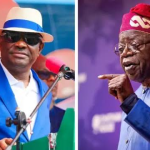






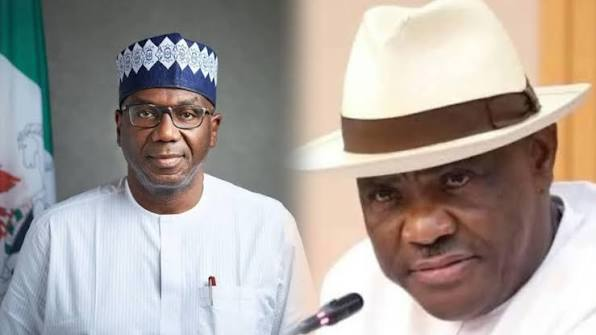
Federal Capital Territory Minister Nyesom Wike has launched one of his most personal political attacks yet on Kwara State Governor AbdulRahman AbdulRazaq, accusing him of championing a campaign against him and mocking what he described as the governor’s apparent tendency to blame him for every political problem in the state.
- Advertisement -

Speaking during an interview on Arise TV’s Prime Time, Wike took direct aim at AbdulRazaq, accusing him of championing a campaign against him and turning virtually every political problem into a Wike issue. Wike’s attack was laced with sarcasm.
“Anytime he sees snake, it’s Wike. Anytime he sees any reptile, it’s Wike. Any day he doesn’t eat, it’s Wike,” the FCT minister said.
The remark was not an isolated jab. Wike said AbdulRazaq had been at the forefront of a campaign against him and disclosed that he had confronted the Kwara governor over what he described as the sustained political hostility.
“Take for example, Kwara, he has been the one championing this campaign against me everywhere. Yes, I have confronted him too. I don’t talk about what I cannot defend,” Wike said.
The confrontation has become one of the more bitter offshoots of the political realignment now taking shape ahead of the 2027 elections.
And in Wike’s telling, the Kwara governor’s grievance is tied to the emergence of political candidates and former APC figures whom the minister says he helped accommodate under the PDP.
Wike’s choice of words was deliberate. Rather than respond to AbdulRazaq in the language of conventional political disagreement, he turned the accusation into a personal taunt.
“Anytime he sees snake, it’s Wike. Anytime he sees any reptile, it’s Wike. Any day he doesn’t eat, it’s Wike.”
- Advertisement -

The minister repeated the line while describing what he considers the governor’s preoccupation with him. Wike’s argument is that AbdulRazaq has turned him into the explanation for political developments in Kwara that the governor finds uncomfortable.
But Wike insists he has no reason to avoid the confrontation.
“Yes, I have confronted him too. I don’t talk about what I cannot defend,” he said.
The accusation is significant because it suggests the dispute is no longer confined to disagreement over the Rainbow Coalition. Wike is alleging that AbdulRazaq has actively worked to build a political campaign against him across the state.
AbdulRazaq has not publicly substantiated Wike’s account in the material reviewed here and Wike’s allegations remain his own account of the dispute.
Wike was particularly direct when the discussion turned to Kwara.
“Take for example, Kwara, he has been the one championing this campaign against me everywhere.”
The choice of the word “championing” is central to Wike’s accusation.
He was not merely describing AbdulRazaq as a politician who disagreed with him. He was accusing the governor of actively driving the campaign.
The dispute, according to reporting on Wike’s remarks, centres partly on allegations that Wike was sponsoring political candidates in Kwara against those preferred by AbdulRazaq. Wike rejected that characterisation and turned the argument back on the governor.
His response was essentially that AbdulRazaq could not complain about political figures who had found an alternative platform while ignoring the role Wike said he played in accommodating aggrieved APC politicians.
At the heart of the quarrel is a question that goes beyond personalities: who has the right to determine which candidates emerge and which politicians receive political backing in Kwara? Wike has rejected the suggestion that he was simply importing candidates into Kwara to undermine the governor.
His argument is that politicians who became uncomfortable within the APC needed somewhere to go, and that the PDP provided that political space. He has pointed to the accommodation of aggrieved APC figures as part of the political work he says he and his allies carried out.
In Wike’s telling, those politicians were not necessarily strangers to the political establishment. They were people who had been part of the APC structure but became dissatisfied with developments within the party.
And rather than abandon them, Wike says they were given a platform in the PDP. That is the political contradiction he wants AbdulRazaq to answer.
If the governor regards the emergence of those politicians under another platform as an attack on his political structure, Wike’s argument is that AbdulRazaq should also account for why those politicians became aggrieved in the first place.
Wike also mocked the scale of the political battle in Kwara, arguing that AbdulRazaq would have to possess extraordinary political control to prevent the movement of politicians within the state.
At one point, he said:
“You removed three senators; you removed members of the House of Representatives, you must be a super governor to survive it.”
The remark was directed at the governor’s handling of politicians and political figures who, according to Wike’s account, had become disconnected from the APC structure in Kwara. Wike’s point was that the movement of several political actors could not simply be blamed on an external figure.
If political actors were leaving or becoming aligned with another platform, he suggested, the governor could not simply reduce the development to Wike’s alleged interference. He wanted the internal political dynamics of Kwara to be examined as well.
The dispute also reaches into the question of who actually provided political opportunities to the politicians now at the centre of the Kwara contest. Wike has argued that his political network gave former APC figures a platform when they needed one.
That claim matters because AbdulRazaq’s reported accusation was that Wike was supporting candidates against those preferred by the governor. Wike’s counterargument was that political candidates do not become the property of a governor simply because they operate in his state.
And he has challenged the idea that his involvement should automatically be interpreted as an attempt to destroy AbdulRazaq. His position is that he was participating in normal political competition and providing a platform to politicians who had become aggrieved within the APC.
That dispute over political ownership, who brought whom into the contest, who gave whom a platform and who is responsible for the resulting realignment sits at the centre of the Kwara quarrel.
Wike’s criticism of AbdulRazaq also reflects a broader disagreement over what political loyalty means. The FCT minister has accused some politicians of being more interested in demonstrating publicly that they are working for President Bola Tinubu than in understanding the political strategy around the President.
He has rejected the idea that supporting Tinubu’s re-election requires him to surrender his own political relationships or stop PDP candidates from contesting other elections.
That position has put him directly at odds with the APC governors, including AbdulRazaq. The Progressive Governors Forum has since taken a formal position against political arrangements that it believes could undermine APC candidates or weaken the party ahead of 2027. But Wike’s quarrel with AbdulRazaq predates that formal position.
His accusation is that the Kwara governor was already working against him and championing a campaign against him before the current confrontation over the Rainbow Coalition reached its present intensity.
That line may be one of the most revealing parts of Wike’s attack.
“I don’t talk about what I cannot defend.”
It was Wike’s way of signalling that his accusation against AbdulRazaq was not, in his view, a casual political insult. He said he had confronted the governor directly.
The remark also fits the broader character of Wike’s response throughout the interview: rather than retreat from the allegations being made against him, he repeatedly challenged his accusers to confront him with specifics.
In the Kwara case, he has chosen to return the fire directly at AbdulRazaq.
Strip away the “snake” and “reptile” language and the dispute reveals a more consequential fight over political control.
AbdulRazaq is the sitting governor of Kwara and chairman of the Nigerian Governors’ Forum, while Wike is a former governor and remains one of the most influential political figures within the PDP camp supporting Tinubu’s re-election.
The question is how much room each man has to operate politically inside Kwara.
AbdulRazaq’s position is that political activity that threatens his preferred candidates or political structure is an attempt to weaken his administration and influence. Wike’s position, as expressed in his remarks, is that he has every right to maintain political relationships and support politicians who choose to work with him. The resulting clash has turned personal.
Hence Wike’s description of AbdulRazaq as a politician who, in his words, sees Wike in “every” political problem. The Kwara dispute is now part of the larger 2027 realignment.
Political figures who were once on the same side are moving between platforms, new alliances are emerging and politicians are increasingly contesting over who can mobilise support for President Tinubu while simultaneously protecting their own interests at the state and National Assembly levels.
Wike insists that his political activity should not be interpreted as hostility to Tinubu.
But for AbdulRazaq and other APC governors, the concern is that a coalition that supports Tinubu for president while producing or backing candidates outside the APC could weaken the party in other contests. That disagreement has become one of the central political fault lines around Wike’s Rainbow Coalition.
Wike, however, has refused to accept the premise that the APC governors can dictate the political choices of everyone operating around the President. And in AbdulRazaq, he has found a particularly direct target.
His message is unmistakable: he says the Kwara governor is actively campaigning against him, he says he has confronted him, and he rejects the suggestion that he should be blamed for every political realignment in the state.
For emphasis, Wike put it in the language only Wike could have chosen:
“Anytime he sees snake, it’s Wike. Anytime he sees any reptile, it’s Wike. Any day he doesn’t eat, it’s Wike.”
The insult may be memorable. But underneath it is a serious political fight over candidates, party defections, political platforms and who gets to decide the direction of Kwara’s politics heading into 2027.