







An ICT expert and digital literacy advocate, Israel Ihaza, has warned that the growing damage to fibre-optic cables should no longer be treated as a problem affecting only telecommunications companies, saying the consequences are increasingly being felt by banks, businesses and ordinary Nigerians.
- Advertisement -

Speaking on Radio One 103.5 FM, Ihaza said telecom infrastructure had become deeply embedded in everyday life, supporting mobile banking, Point of Sale (POS) transactions, internet services, businesses, government platforms and other digital activities.
He said many Nigerians may not immediately understand the importance of fibre-optic cables because much of the infrastructure is buried underground and does not have the obvious visibility of electricity infrastructure.
“But what they don’t understand is that these cables power economies. If some of these cables are down, the financial ecosystem is down, banking generally,” he said.
Ihaza also warned against the attitude of members of the public who see damage to telecom infrastructure as somebody else’s problem, adding “Because what we’re seeing currently in Nigeria is, ‘Oh, if there’s an accident, what’s my business? As far as it’s not affecting me.’
Meanwhile, it’s affecting everybody,” he said.
His comments come amid growing concern over repeated fibre cuts across the country.
The Nigerian Communications Commission (NCC) said 5,934 fibre-optic cable cuts were recorded in the first six months of 2026, averaging about 65 incidents every day. The regulator has linked many of the incidents to road construction, excavation and other civil works.
The scale of the problem has also attracted a direct financial cost for telecommunications operators.
- Advertisement -

According tothe Association of Licensed Telecommunications Operators of Nigeria (ALTON), operators spent about N2.2 billion on direct repairs arising from fibre cuts in the first half of 2026. The figure excludes revenue lost during outages and capital that may be diverted from network expansion to emergency repairs.
For MTN Nigeria, Chief Technology Officer Yahaya Ibrahim said the company budgets about N7 billion annually for fibre relocation projects arising from road expansion and other incidents affecting existing infrastructure.
He said such expenditure could otherwise be deployed towards new network infrastructure.
An additional estimate by energy expert Dare Osamo put the potential wider economic cost of fibre cuts at about N70 billion annually, based on the pace of reported incidents in the first half of 2026. That figure is an expert estimate, not an official NCC assessment of national losses.
Beyond the cost to operators, the disruption can translate into practical problems for Nigerians.
A damaged fibre route can affect connectivity used by POS terminals, mobile banking, online payments, businesses and other digital services. The NCC has described communications infrastructure as a critical national lifeline supporting banking, government services, education, healthcare, commerce, security and emergency communications.
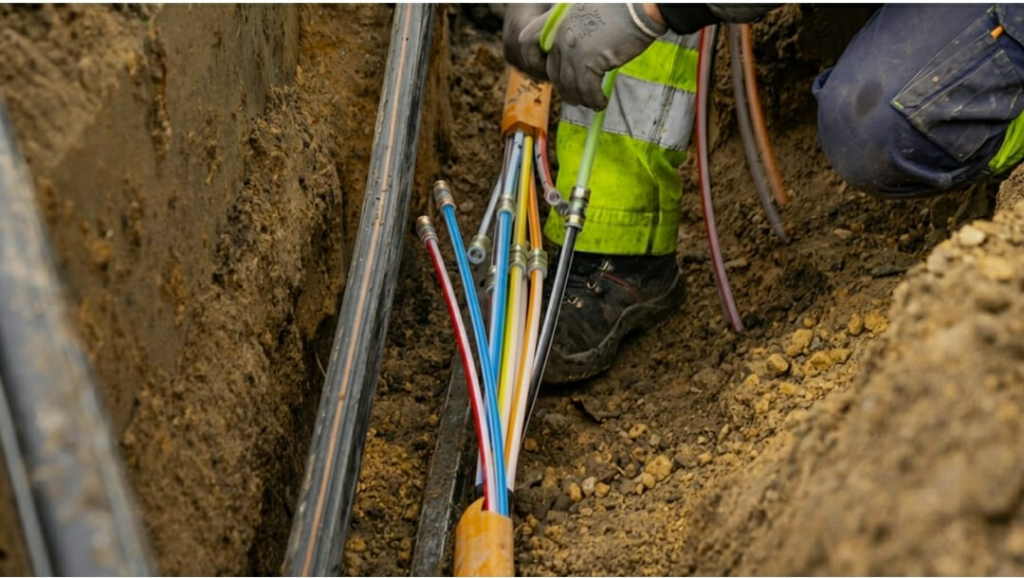
Ihaza said the response therefore requires greater public awareness, better coordination with construction workers and stronger protection of fibre routes.
He called for fibre routes to be clearly identified in the same way that pipelines and other underground infrastructure are marked.
“Just the same way we have labeling for pipelines—‘Oh, this area, there are pipelines here’—I think we need to come up with that as well, where we know, okay, in certain areas we have fibre optic cables, so do not disrupt it,” he said.
He also urged construction companies, engineers, property developers and other workers involved in excavation to be properly educated about the presence of fibre infrastructure.
According to him, CCTV and greater involvement of local security personnel could help identify those deliberately vandalising or removing cables, while members of the public should report suspicious activities rather than ignore them.
The issue is not limited to deliberate vandalism. Ihaza noted that accidental damage during road construction, excavation and other public works can equally disrupt services, making awareness and proper coordination important.
The NCC and other government agencies have similarly treated the issue as one extending beyond the telecommunications sector. The Office of the National Security Adviser has warned that fibre damage can disrupt governance, economic productivity, public services and the daily lives of Nigerians, while telecom infrastructure is covered under Nigeria’s Critical National Information Infrastructure framework.
For ordinary Nigerians, Ihaza’s argument is that the significance of a damaged fibre cable may only become obvious when a bank transaction fails, a POS payment cannot go through, a business loses connectivity or an essential digital service becomes unavailable.
The growing dependence of daily economic activity on connectivity, he said, makes protecting telecom infrastructure a matter of public concern rather than an issue to be left solely to network operators.