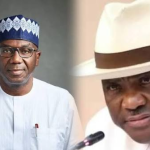







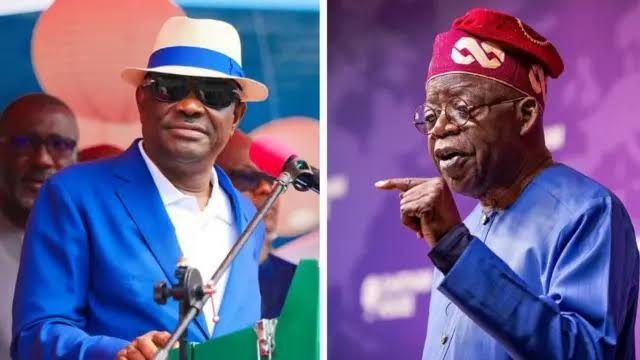
Minister of the Federal Capital Territory, Nyesom Wike, has drawn a sharp political distinction between his support for President Bola Ahmed Tinubu’s 2027 re-election bid and his continued membership of the Peoples Democratic Party, telling APC governors that they cannot dictate the terms of his political choices.
- Advertisement -

In a lengthy and combative interview on Arise Prime Time, Wike rejected the suggestion that his so-called “Rainbow Coalition” was an alliance negotiated with the All Progressives Congress or its governors.
He also dismissed the idea that supporting Tinubu at the presidential level requires him to support APC candidates in governorship, National Assembly and State House of Assembly elections.
His position comes as the Progressive Governors Forum (PGF), the umbrella body of APC governors, has declared that its members will not participate in, support or endorse political arrangements capable of undermining Tinubu’s re-election, weakening the APC or adversely affecting APC candidates at any level.
But Wike insisted that no such agreement was ever made with him.
“There’s no day I went to the Governors Forum to align with Rainbow Coalition. There’s no day,” he said.
“I was already talking about alliance with party and never one day gone to APC for us to have alliance.”
For Wike, the issue is straightforward: he has publicly committed himself to supporting Tinubu for a second term, but that commitment does not amount to joining the APC or surrendering his political influence to APC governors.
“I have never one day sided with APC. I have no business for that,” he said.
- Advertisement -

He added that his position had always been known to the President.
“There is not me, the thing I said, and the president knows. And there’s nothing I have done that I have never told the president is what I intend to do.”
‘We Met With Mr President, Not APC Governors’
Wike traced his support for Tinubu to the 2023 presidential election, when he and the other members of the G5 governors broke with the PDP’s official position and backed Tinubu. He stressed that the decision was not reached through negotiations with APC governors.
“When in 2023 we said we are going to support Tinubu… We met with Mr. President and told Mr. President, We’re going to support you. And I have never hidden that,” he said.
According to Wike, his decision was influenced by his belief that power should move to the South after the Muhammadu Buhari presidency.
“Mr. President, as far as the President is concerned, we’re going to support you. Why? Because of my belief that it is the turn of the South to produce the presidency, and it will have been done for eight years, and so it should be fair if the opposition goes back to the North.”
Wike said the G5’s support for Tinubu in 2023 should not now be interpreted as evidence that the group had entered into a broader political arrangement with the APC. He challenged the governors to explain why they were only now treating the coalition as a problem.
“How did it come now, all of a sudden, that it’s causing a problem?” he asked.
“When did the coalition come about? Why didn’t they say it then?”
Wike Challenges APC Governors Over 2023 Voting Pattern
Wike also turned the argument back on the APC governors, using the 2023 elections in Imo and Ebonyi as examples of how voters can support a presidential candidate from one party and legislative candidates from another.
He specifically challenged Imo Governor Hope Uzodimma over the state’s 2023 presidential and National Assembly results. Wike said Tinubu did not receive 10 per cent of the presidential vote in Imo State, yet APC secured two Senate seats.
He also cited figures of 360,000 votes for the Labour Party and 66,000 for the APC in the presidential election, arguing that the results raised questions about how voters made different choices in elections held on the same day.
His argument was that voters could make separate choices for president and National Assembly candidates without being “confused”, as some political actors might suggest.
“In that case, what happened? What happened that the electorate knew how to vote for a presidential candidate and then voted for APC on their national assembly candidate?” Wike asked.
He made a similar point about Ebonyi, where he said Tinubu lost the presidential election while APC candidates won Senate seats.
“Nigerians should really go and check what really happened,” he said.
Wike’s argument was that the 2023 results demonstrated that voters could split their choices across different races, precisely the political behaviour the APC governors now appear determined to prevent in 2027.
‘What Has That Got to Do With My Party?’
Wike rejected the suggestion that his support for Tinubu automatically makes him responsible for the electoral fortunes of APC candidates. He argued that politicians can support a presidential candidate while retaining the freedom to support candidates from other parties in legislative or state-level contests.
He cited Anambra Governor Chukwuma Soludo as an example, asking whether Soludo’s support for Tinubu necessarily meant he could not support candidates of his own party. He made similar references to other politicians and political groups that, according to him, support Tinubu while retaining their own political identities.
The central question, he said, was simple:
“What has that got to do with my party?”
Wike has since made the position even clearer, saying his support is specifically for Tinubu’s presidential bid and does not mean the PDP has agreed to abandon other electoral contests.
Wike Calls Governors ‘Politically Lazy’
The FCT minister did not stop at rejecting their argument. He took direct aim at the governors behind the position, describing them as politically smart but “politically lazy”.
“With all due respect to you, what I see the people who had that press conference, they are smart, like the 419ers. They are smart, like the 419ers, but they are politically lazy. Unfortunately,” he said.
He also singled out Kwara Governor AbdulRahman AbdulRazaq, accusing him of repeatedly blaming him for political problems.
“Anytime he sees snake, it’s Wike. Anytime he sees any reptile, it’s Wike. Any day he doesn’t eat, it’s Wike.”
Wike questioned why governors who had been elected to govern their states would spend so much time discussing him rather than concentrating on their responsibilities.
“I don’t see people who choose give time to gossip, while they are doing the work that they have been given.”
‘They Wanted to Give Us Candidates’
One of the most revealing parts of the interview came when Wike disputed the suggestion that his influence over candidates was itself the problem. He alleged that some APC governors wanted to dictate the candidates that should emerge in particular contests.
“Who told you that we are presenting the candidates?” Wike asked.
“They wanted to give us candidates of their own choice to present in that election.”
He rejected the idea that political leaders should be allowed to determine candidates simply because they control government structures.
“My baby is not contesting the election.”
For Wike, the disagreement is therefore not simply about whether governors have political influence. He acknowledged that they do. But he argued that their influence should principally be measured by what they can deliver in their own states.
“They are governors. I agree. I agree. I have no dispute that they have influence, but the influence should come more in your own state, as far as this election is concerned.”
He then turned the argument directly toward the presidential election.
“Because at the end of the day, if the president does not win in your state, what will we be talking about?”
‘A Governor Who Cannot Deliver His State Should Not Talk About Influence’
Wike went further, questioning the political strength of governors who, in his view, could not deliver their states for Tinubu in the presidential election.
“A governor that has influenced that, that the president cannot win election in his state, should not say someone has been influential,” he said.
The argument goes to the heart of the emerging disagreement between Wike and some APC governors: who actually possesses the political influence capable of determining how voters behave in 2027? The governors appear to be insisting on party discipline and a unified APC electoral structure.
Wike, however, is arguing for a more fluid model in which support for the president can cut across party lines while parties continue to contest other elections.